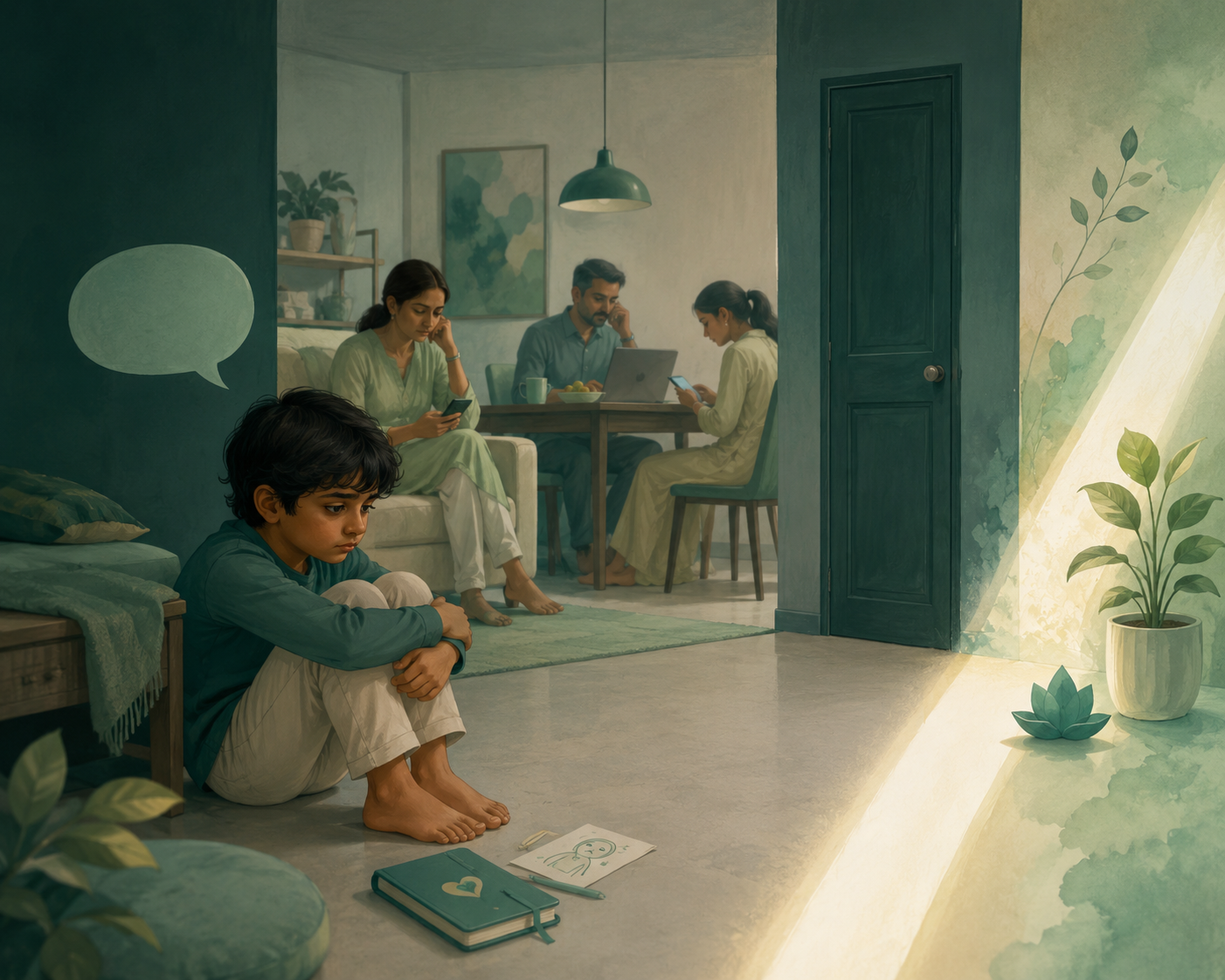
1. You Were Provided For, But Rarely Emotionally Comforted#
One common experience is hearing:
“We gave you everything.”
Perhaps you were fed, educated and protected. But when you were afraid, sad, confused or hurt, you may have felt alone. Your physical needs were addressed, but your emotional needs were not.
You may remember thinking:
“I had everything, so why was I unhappy?”
“I had no right to complain.”
“My problems were never serious enough.”
“I should not need anyone.”
This can create confusion in adulthood because a person may recognise that their parents worked hard while also acknowledging that they felt emotionally unsupported. Both things can be true. A parent may have made significant sacrifices and still have struggled to provide emotional attunement.
2. Your Feelings Were Regularly Dismissed#
Many children learn that some emotions are acceptable while others are not.#
Happiness may be welcomed.
Achievement may be celebrated.
But sadness, fear, anger or disappointment may be dismissed.
Common responses can include:
“Stop crying.”
“Don't be dramatic.”
“Why are you so sensitive?”
“You are making a big issue out of nothing.”
“You are fine.”
“This is not a real problem.”
Over time, a child may stop asking:
“What am I feeling?”
and start asking:
“Will other people think my feeling is valid?”
This can make emotional awareness difficult later in life.
3. You Were Expected to Be “Strong” Very Early#
Some children are praised for being unusually mature.They may hear:
“You are the sensible one.”
“You understand everything.”
“You don't create problems.”
“You are stronger than your sibling.”
“We can depend on you.”
Being responsible is not inherently harmful. The concern arises when a child is expected to manage adult emotions, family conflict or responsibilities beyond their developmental capacity.
A child may become:
This is sometimes connected with parentification, in which a child takes on responsibilities that should belong to adults. The child may appear mature on the outside while privately feeling exhausted, anxious or alone.
4. You Were Not Allowed to Express Anger Safely#
Anger is an emotion. It is not automatically bad behaviour. Children need to learn how to express anger safely. But in some families, any disagreement may be interpreted as:
Disrespect
Disobedience
Bad character
Lack of gratitude
A child may therefore learn:
“If I am angry, I am a bad person.”
As an adult, this may appear as:
Difficulty saying no
Avoiding conflict
Suppressing resentment
Sudden emotional explosions
Feeling guilty after expressing needs
Fear of disappointing others
Healthy emotional development does not mean allowing children to behave aggressively. It means helping them understand both the emotion and the behaviour.
For example:
“I understand that you are angry. You cannot hit someone. Let's talk about what happened.”
This is different from:
“You are not allowed to feel angry.”
5. You Were Compared Instead of Understood#
Comparison is common in many cultures, including Indian families.
Children may be compared with:
Siblings
Cousins
Neighbours
Classmates
Family friends
They may hear:
“Look at your cousin.”
“Your sister never behaves like this.”
“Other children are doing better.”
Occasional comparison may be intended as motivation.
But persistent comparison can communicate:
“Who you are is not enough.”
The child may begin to believe that love, approval and attention must be earned through performance. This can contribute to perfectionism and a constant fear of failure.
6. Your Achievements Received More Attention Than Your Emotional Life#
Some children receive the most attention when they:
But when they are struggling emotionally, the response may be minimal.
This can teach a child:
“My value comes from what I achieve.”
Later, the person may find it difficult to rest without guilt.
They may constantly chase:
Better grades
More productivity
Higher income
More approval
More achievements
Yet achievement may never produce the emotional security they were originally seeking.
7. You Had to Hide Problems to Protect the Family#
Some children become highly aware of family stress.
They may notice:
They may decide:
“I cannot add to the family's problems.”
So they hide:
This may be especially common in families where children are expected to be grateful and not create additional worry. But a child should not have to become invisible in order to protect adults from their own emotions.
8. You Were Not Asked How You Were Really Feeling#
A child can live in a home where practical conversations happen every day:
But emotional conversations may rarely happen.
Nobody asks:
What has been difficult for you lately?
What are you worried about?
What made you happy today?
What are you feeling?
What do you need from me?
Over time, the child may become disconnected from their own emotional world. They may know how to describe events but struggle to describe feelings.
9. You Were Punished or Mocked for Crying#
Crying is one of the ways children communicate distress. Repeatedly mocking, shaming or punishing a child for crying can teach them to suppress emotional expression.
They may learn:
“Crying is embarrassing.”
“I must hide my emotions.”
“Nobody wants to deal with my sadness.”
As adults, they may feel uncomfortable when:
Someone cries in front of them
They themselves become emotional
They need comfort
They are asked to talk about painful experiences
Some people describe this as feeling emotionally “frozen.”
10. You Were Expected to Understand Adults, But Adults Did Not Try to Understand You#
A child may repeatedly hear:
“You are old enough to understand.”
But adults may not make the same effort to understand the child's developmental needs.
The child may be expected to understand:
A parent's stress
A parent's anger
Family sacrifices
Financial problems
Social expectations
But nobody asks:
“What is happening inside the child?”
Children can be empathetic and understanding. However, empathy should not become a one-way responsibility. Children also deserve adults who try to understand them.
11. You Became Extremely Independent#
Independence can be healthy. But sometimes, extreme independence is a form of emotional adaptation.
A person may say:
“I don't need anyone.”
“I will handle it myself.”
“I don't like asking for help.”
“I don't want to depend on anyone.”
“People always disappoint you.”
The person may appear strong.
But underneath, there may be a belief:
“If I need someone, I will probably be disappointed.”
Learning to become self-reliant can be valuable. Having to become emotionally self-sufficient because there was no reliable emotional support can be painful.
12. You Became the “Good Child”#
Some children learn that the safest way to receive approval is to be:
Quiet
Obedient
Successful
Helpful
Emotionally controlled
Low-maintenance
They may rarely express disagreement.
They may apologise quickly.
They may constantly monitor other people's moods.
This can become people-pleasing in adulthood.
The person may struggle to answer a simple question:
“What do you want?”
because they have spent years asking:
“What will keep everyone else happy?”
13. You Felt Lonely Even When You Were Surrounded by Family#
Emotional loneliness is not the same as physical isolation. A person can live with parents, siblings and extended family and still feel emotionally alone.
They may have many people around them but no one with whom they can safely say:
“I am scared.”
“I am not okay.”
“I need comfort.”
“I don't know what to do.”
This kind of loneliness can be difficult to explain because outsiders may respond:
“But you have a family.”
Having people around you and feeling emotionally connected to them are not always the same thing.
14. Your Problems Were Compared With Someone Else's Suffering#
A child may hear:
“People are starving. You are worried about this?”
“Some children do not even have parents.”
“You have a home and education. What are you complaining about?”
Gratitude and emotional validation can coexist. A child can be privileged in one area and still be emotionally hurt in another. Someone else's suffering does not make your feelings unreal.
15. You Struggle to Know What You Need#
One of the less obvious signs of emotional neglect is difficulty identifying personal needs. You may know how to fulfil responsibilities.
But you may struggle with questions such as:
When a child's feelings are repeatedly ignored, the child may stop developing confidence in their own internal signals. This is not a character flaw. It can be a learned survival pattern.