
Back to articles
13 min read

Affordable Online Therapy in India: What to Expect in Your First ₹99 Session

Nervous about trying therapy? Learn what to expect in your first ₹99 online counselling session in India, how to prepare, what you can discuss, and how to choose the right therapist.

Ritik Raj

Ritik Raj

Introduction: What if starting therapy did not have to feel like a huge commitment?

Maybe you have been thinking about therapy for weeks.
You may have searched:

  • “Do I really need therapy?”

  • “What if I do not know what to say?”

  • “Will the therapist judge me?”

  • “What happens in the first session?”

  • “Is online therapy actually helpful?”

  • “Can I afford regular counselling?”

These questions are completely understandable.

For many people in India, the first step towards therapy can feel emotionally difficult and financially uncertain. You may want support, but you may not be ready to commit to a long-term therapy plan or pay a large amount for your first appointment.

That is why an affordable introductory session can make starting easier.

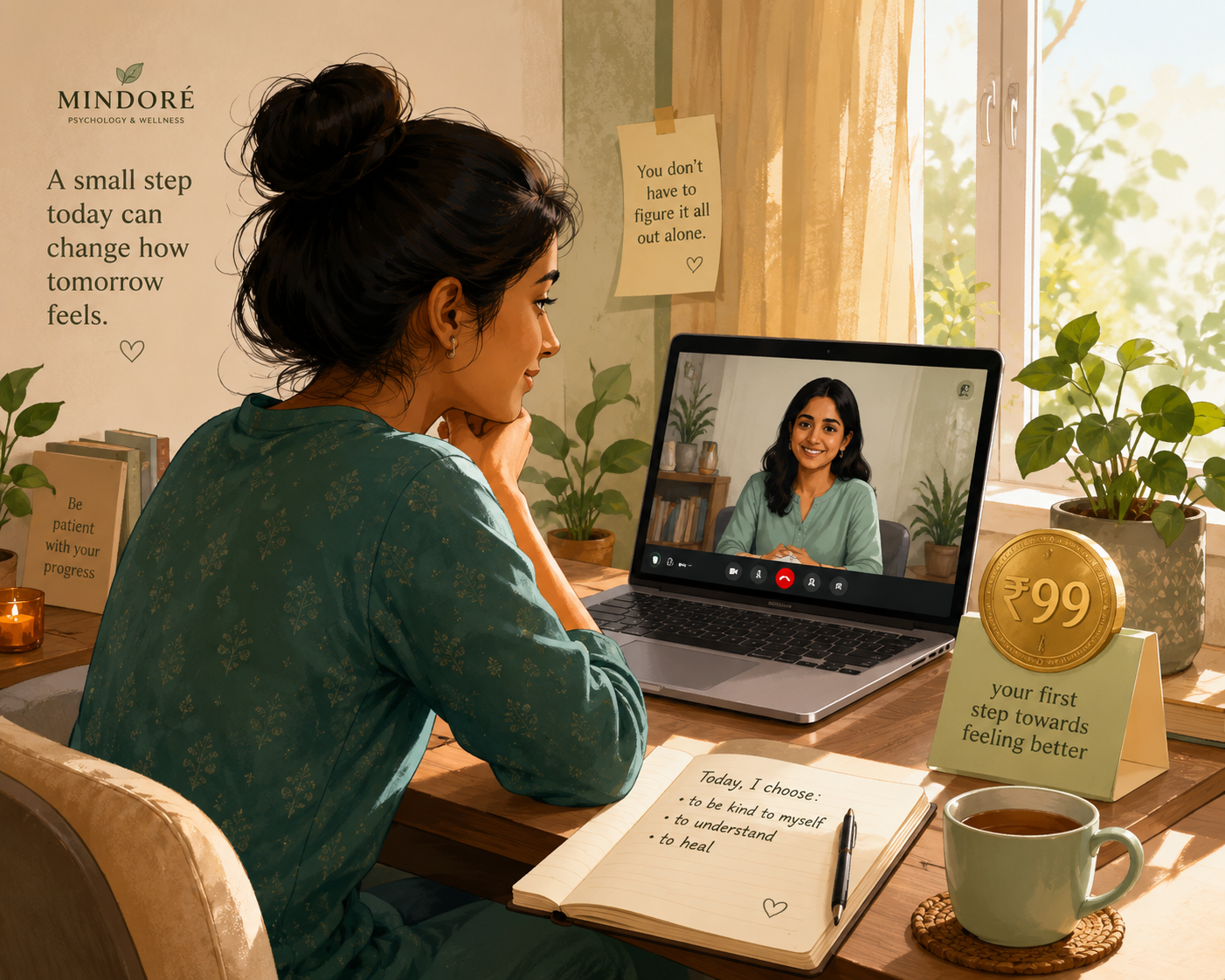
At Mindore, selected therapists offer an introductory session for ₹99, giving you an opportunity to begin a conversation, understand the counselling process, and explore whether the therapist feels like a suitable fit for your current concerns. For example, Neha Beniwal’s Mindoré profile lists a ₹99 introductory session and a regular session fee of ₹599.

The important thing to remember is this:

Your first therapy session does not require you to have everything figured out.

You do not need the perfect explanation.
You do not need to know your diagnosis.
You do not need to prepare a dramatic story.
You simply need to begin with what feels difficult right now.

What Is Affordable Online Therapy in India?

Affordable online therapy refers to professional mental health support delivered digitally through online platforms, usually through video or audio sessions.
Online counselling may help people access support from the privacy and comfort of their own environment. It can also make it easier for people living in different cities, working unusual hours, or feeling nervous about visiting a clinic to begin a conversation.
Mindoré is designed as a digital mental wellness platform for people seeking emotional support and professional counselling, with an emphasis on culturally relevant care, privacy, accessible support, and therapists who understand the social and family contexts of life in India.
Depending on the therapist and service, people may seek support for concerns such as:

  • Anxiety and overthinking

  • Academic pressure

  • Career confusion

  • Relationship difficulties

  • Family conflict

  • Emotional exhaustion

  • Low self-esteem

  • Stress and burnout

  • Grief and loss

  • Social anxiety

  • Life transitions

  • Personal growth

What Is a ₹99 Introductory Therapy Session?

A ₹99 introductory session is a low-cost way to take the first step towards professional counselling. It is important to understand that the exact format, duration, and terms of an introductory session can depend on the therapist and the service offered. You should always review the session details before booking.
The purpose of an introductory session may include:

  1. Understanding what is currently troubling you.

  2. Getting a sense of how counselling works.

  3. Meeting or speaking with the therapist.

  4. Asking questions about the therapeutic process.

  5. Exploring whether the therapist may be a suitable fit for your needs.

  6. Understanding possible next steps.

A first appointment is generally not about “fixing your entire life” in one conversation. In psychotherapy, an initial session commonly involves understanding what brought you to therapy, discussing your concerns and goals, and addressing practical matters such as confidentiality and the therapy process.

The ₹99 session is a starting point—not a promise of an instant solution.

Therapy is usually a process. A single session may help you organise your thoughts, feel heard, understand your concerns more clearly, or decide what kind of support you may want next.

What to Expect in Your First ₹99 Online Therapy Session

1. You may feel nervous before the session

This is normal. You may wonder:

  • “What should I say?”

  • “What if I start crying?”

  • “What if I go blank?”

  • “What if my problem is not serious enough?”

  • “What if the therapist thinks I am overreacting?”

You are not expected to perform during therapy. Your therapist is there to guide the conversation. Many people feel nervous during their first psychotherapy appointment, and preparing a few points beforehand can make the experience easier.


2. The therapist may ask what brought you to counselling

You may hear questions such as:

  • “What made you decide to seek support now?”

  • “What has been difficult recently?”

  • “How has this been affecting your daily life?”

  • “What would you like help with?”

  • “What would you like to understand better?”

You do not need to give a perfect answer.
You can simply say:

“I have been feeling overwhelmed and I am not sure where to begin.”

That is enough to start.


3. You may talk about your current concerns

You might discuss:

  • A recent stressful situation

  • A relationship problem

  • Family pressure

  • Anxiety or overthinking

  • Career uncertainty

  • Academic stress

  • Feeling emotionally exhausted

  • Difficulty managing your emotions

  • A change in your life

  • Something you have been carrying for a long time

You decide how much you are comfortable sharing.
You do not have to reveal every personal detail immediately.
A good therapeutic relationship develops over time, and trust may take more than one conversation.


4. The therapist may ask questions to understand the bigger picture

A therapist may want to understand how your concerns affect areas such as:

  • Sleep

  • Daily functioning

  • Relationships

  • Work or studies

  • Mood

  • Concentration

  • Motivation

  • Emotional wellbeing

This does not mean you are being judged or examined. The purpose is to understand your experience more clearly and consider what type of support may be appropriate.


5. You can ask questions too

Therapy is not a one-sided interview. You are allowed to ask questions.
For example:

  • “What is your counselling approach?”

  • “What concerns do you usually work with?”

  • “How often do people usually attend sessions?”

  • “What can I expect from future sessions?”

  • “What happens if I do not feel comfortable?”

  • “How are cancellations handled?”

  • “What are the session fees after the introductory session?”

These are reasonable questions. You are choosing someone with whom you may discuss personal parts of your life. It is appropriate to understand the process.

What You Do NOT Have to Do in Your First Session

You do not have to:

❌ Tell your entire life story
❌ Know exactly what is wrong
❌ Have a diagnosis
❌ Use psychological terminology
❌ Give a perfect explanation
❌ Cry to prove that you are struggling
❌ Accept every suggestion immediately
❌ Pretend that everything is fine
❌ Continue with a therapist who does not feel like a suitable fit

You can simply begin with:

“I have been struggling lately, and I would like help understanding what is happening.”

How to Prepare for Your First Online Therapy Session

You do not need extensive preparation. However, these simple steps may help.

Before the session, think about three things:

1. What is bothering me most right now?

For example:

“I cannot stop overthinking about my relationship.”

“I feel lost about my career.”

“I am constantly stressed about my studies.”

“I feel emotionally exhausted but I do not know why.”

2. How is it affecting my life?

Consider:

  • My sleep

  • My concentration

  • My relationships

  • My work or studies

  • My mood

  • My daily routine

3. What would I like to be different?

Your goal does not need to be perfect. It could simply be:

“I want to understand myself better.”

“I want to stop feeling so overwhelmed.”

“I want to handle my emotions better.”

“I want clarity about what I am going through.”

A Simple 5-Minute Preparation Exercise

Before your appointment, complete these sentences:

Recently, I have been feeling:


The main thing troubling me is:


It affects my life by:


I have already tried:


If therapy helps, I would like to:


You can keep these notes with you during the session. You do not have to read them word for word. They are simply there in case you go blank.

What Happens After the First Session?

The next step depends on your needs, your preferences, and the therapist's assessment of how they may be able to support you. You may decide to:

  • Continue with the same therapist.

  • Schedule regular sessions.

  • Ask additional questions before deciding.

  • Consider another therapist whose experience or approach may feel more suitable.

  • Seek a different level or type of professional support if your needs require it.

Finding the right therapist can take time. Different therapists have different areas of experience, communication styles, and therapeutic approaches. A therapist who is a good fit for one person may not necessarily be the best fit for someone else.

Mindore's therapist directory allows users to explore therapist profiles, areas of focus, languages, qualifications, and session information before booking.

How to Choose the Right Online Therapist

When exploring therapists, consider:

What to Look At

Why It Matters

Areas of experience

The therapist may be familiar with concerns similar to yours

Qualifications

Helps you understand their educational and professional background

Language

Speaking in a comfortable language can make communication easier

Therapeutic approach

Different therapists may work differently

Personal comfort

Feeling safe and respected is important

Session pricing

Helps you plan for ongoing support

Availability

Consistency can make regular therapy easier

For example, Neha Beniwal's Mindore profile describes her as having an M.Sc. in Counselling and Family Therapy, speaking English and Hindi, and working with concerns including anxiety, career stress, depression, and relationships. Her profile describes an empathetic, client-centred approach and lists a ₹99 introductory session.

Is Online Therapy Right for Everyone?

Online counselling can be a convenient and accessible way to seek support, but it is not automatically the right format for every situation. Your therapist may recommend a different form or level of care if your needs require it.
Online therapy may be especially convenient for people who:

  • Prefer speaking from home.

  • Have difficulty travelling to a clinic.

  • Live in a location with limited access to mental health professionals.

  • Feel more comfortable beginning support online.

  • Want to explore counselling before committing to regular sessions.

Digital mental health services can improve access to support, but privacy, safety, informed consent, and appropriate clinical care remain important considerations.

What If You Cry During the Session?

You are allowed to cry.

You are also allowed not to cry.

There is no correct emotional response to therapy.

Some people cry because they finally feel safe enough to express something they have been holding in.

Others feel numb.

Some people talk continuously.

Others need time to find the right words.

All of these experiences can happen.

You do not have to apologise for having emotions.

What If You Go Blank?

This happens more often than people realise.
You can say:

“I do not know how to explain this.”

“I am feeling nervous.”

“I had so many things to say, but now I cannot remember any of them.”

“Can you ask me some questions to help me begin?”

Your therapist can help guide the conversation. You can also keep a note on your phone with three points you want to discuss.

Myth vs Fact: Your First Therapy Session

Myth

Fact

“I need to have a serious mental illness to go to therapy.”

People seek counselling for many reasons, including stress, relationships, emotional difficulties, life transitions, and personal growth.

“The therapist will tell me exactly what to do.”

Therapy is generally a collaborative process that helps you explore concerns and develop understanding and coping strategies.

“I must tell everything in the first session.”

You can share at your own pace.

“If I am nervous, therapy will not work.”

Nervousness is common when beginning something unfamiliar.

“One session will solve everything.”

One session may be a starting point, but meaningful change often develops over time.

“Therapy is only for people who are in crisis.”

Many people seek support before reaching a crisis point.

Do and Don't: Your First Online Therapy Session

Do:

✔ Find a private and reasonably quiet place.
✔ Check your internet connection beforehand.
✔ Keep water nearby.
✔ Write down a few points you want to discuss.
✔ Be honest about what you are experiencing.
✔ Ask questions about the process.
✔ Tell the therapist if you feel uncomfortable or confused.

Don't:

✘ Feel pressured to tell everything immediately.
✘ Assume you must know the correct psychological term for your experience.
✘ Compare your therapy journey with someone else's.
✘ Expect one conversation to solve every problem.
✘ Ignore serious safety concerns.

A Quick Checklist Before Your ₹99 Session

10 minutes before:

☐ Find a private space
☐ Charge your phone or laptop
☐ Check your internet connection
☐ Keep water nearby
☐ Keep your appointment details accessible
☐ Write down the main concern you want to discuss
☐ Take a few slow breaths

During the session:

☐ Speak honestly
☐ Take your time
☐ Ask questions
☐ Say if you do not understand something
☐ Share only what you feel ready to share

After the session:

☐ Notice how you felt during the conversation
☐ Reflect on whether you felt heard and respected
☐ Consider what you would like to do next
☐ Ask about future sessions if you are interested in continuing

When Professional Help May Be Especially Important

Consider reaching out to a qualified mental health professional if emotional difficulties are:

  • Persisting for a long time.

  • Interfering with your daily functioning.

  • Affecting your relationships.

  • Making it difficult to study or work.

  • Affecting your sleep or appetite.

  • Creating intense emotional distress.

  • Becoming increasingly difficult to manage alone.

You do not have to wait until everything becomes unbearable before seeking support.

Important: Therapy Is Not an Emergency Service

An introductory therapy session is not a substitute for emergency mental health care. If you are in immediate danger, have seriously harmed yourself, or feel unable to keep yourself or someone else safe, seek urgent local emergency help or go to the nearest emergency department.
Mindore's terms also state that the platform is not a medical emergency service and that people in crisis should contact emergency services immediately.

Final Thoughts: You Do Not Need to Be “Ready” in a Perfect Way

Many people wait for the perfect moment to begin therapy.
They wait until they can explain their feelings clearly.
They wait until they understand what is wrong.
They wait until the problem becomes “serious enough.”
But therapy can also begin with uncertainty.
You can begin with:

“I do not know what I need.”

“I am tired of feeling this way.”

“Something has been bothering me.”

“I want to understand myself better.”

That can be enough.

A ₹99 introductory session can be a small, affordable first step towards exploring professional support without the pressure of immediately committing to a long-term therapy journey.

You do not have to carry everything alone.

If you are ready to take the first step, explore verified therapists on Mindore and find a professional who may be a suitable fit for your concerns, language, and comfort.

Things to remember

  • Your first therapy session is usually an opportunity to understand your concerns and begin building a therapeutic relationship.

  • You do not need to know exactly what to say.

  • You can prepare a few notes before your session.

  • You can ask questions about the therapist and the counselling process.

  • A ₹99 introductory session can make exploring therapy more financially accessible.

  • The exact format and terms of an introductory session may vary by therapist.

  • Finding the right therapist can take time.

  • Therapy is a process, not an instant solution.

  • You should seek urgent emergency support if you are in immediate danger or facing a mental health crisis.

Need professional mental health support?

Book a counselling session with our psychologists.

Book Session
Ritik Raj

Written by

Ritik Raj